Posts

I blame Foucault

Image
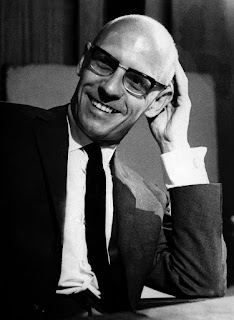
Michel Foucault is the most cited scholar in the social sciences, and his book Discipline and Punish is one of the most cited works. Foucault's influence is hard to underestimate within academia. It is my contention however that his ideas have been a substantial force for ill. Allow me to explain. Michel the Mystic In my view, one of the central problems of postmodern-leftist academic thought is the obsession with unmasking what lurks beneath, to dig beneath what is self evident in pursuit of something substantial and profound below the surface. Reality doesn't simply present itself to us, and common sense is not so common, they say. It is almost mystical in its framing. Academics of this persuasion are like miners digging ever deeper, excavating through the layers, uncovering ever more imperceptible 'truths' (a word which must be deployed in ever-so-knowing scare quotes). Deeper, and deeper they go until the nugget is found; the thing itself, the source, the slime, or...

Performance is not Progress

Image
Q. I've got an observation coming up and I've been told I need to show that my students have made progress in my lesson. How do I do that? A. Well that depends on what you mean by 'progress'. Q. Go on. A. Well, I think progress means that a student knows more about the subject than they did when we started. It's basically synonymous with learning. Q. So, what's a good way of checking for progress? A. If you want to know what someone knows, you ask them questions about it. If you want to see what someone can do, you ask them to do it. But progress is something different. Progress is change over time, not simply a snapshot. So if you want to see if someone has made progress you need a starting point and a destination. You can then compare knowledge at the start of a term, say, and again at the end. As long as your assessment methods are appropriate then you've got yourself evidence of progress. Q. This all seems pretty straightforward. But I need to ...

Integrate - Disintegrate - Reintegrate

Image
There is always much talk of what great teaching should look like, and I have my own thoughts, of course. I've been struck recently by the work of Michael Polanyi, whose work on 'meaning' and 'knowing' has affected me profoundly. It can hardly be helped but to apply some of his ideas to see where they might assist me in my teaching practice. Polanyi's most helpful concept is the idea that all knowing is, in his terms, 'subsidiary-focal integration'. I've  written about this before  in the context of sport. This idea is a remarkably simple one and yet its utility is vast and ranging. In this post I'd like to suggest that an awareness of subsidiary-focal integration (SFI), as the structure of all knowing, helps a great deal with lesson and scheme of work construction. To do this, I will be applying SFI at the level of the individual lesson in order to highlight its applicability. By all means, extend the application of SFI across a series of lesson...

A teacher is an authoritative guide

Image
I've done a spot of travelling in my time, but the most enjoyable trips I've made, the ones which have enriched me the most, have been those trips where I've had a knowledgeable guide. I've had a tour of the Vatican. I've been shown round Florence. I was even guided around Israel for a couple of weeks by a pastor and theologian from Nazareth. What a lot I learned! He took us to the crusader Church of Saint Anne at Bethesda where we sang a hymn, because, he told us, the acoustics are superb. (They are. We drew a decent crowd. Of nuns.) We learnt the comic-tragic tale of the Immovable Ladder. We heard the account of the siege at Masada and saw the astonishing earthen ramp built by the Roman army there. We walked the Via Dolorosa, gazed up at Golgotha, visited the garden tomb, drank Arabic coffee by the roadside in Nazareth, ate fish at the Sea of Galilee, peered over the Mount Precipice. Yep, still there. As we went I had questions. A lot of questions. (I'm that s...

Michael Polanyi and the best ever goal.

Image
"There is no real substitute for a ball struck squarely and firmly". So says Billy Bragg in the song A Lover Sings, and anyone who has played football (soccer, if you must) knows what he means. You know what it's like to make the perfect connection with the ball. You just know. But what is it that enables us to 'just know'? That's what this blog post is about. Think about the last time you hit the perfect strike and sent the ball screaming into the back of the net. (Okay, point taken. Just imagine it.) What did it look like? How did it feel? Did it sound like a thud, or was it some other kind of sound? Were you aware of your surroundings? The opposition? Teammates? It's kind of hard to say, isn't it? We need some way of thinking this through, so let's start with an example, to which we can refer. Here is a short video clip of the best goal ever. (You heard me.) More than we can tell I wonder what the goalscorer Zinedine Zidane would...

Ten Years Since I Quit Teaching

Image
The Road Not Taken? http://s0.geograph.org.uk/geophotos/01/07/70/1077046_d3f400d2.jpg It dawned on me this week that I am approaching the ten year anniversary of quitting teaching after the first half-term of my NQT year. This post is a reflection on what went wrong then, why I'm still in teaching, and, perhaps most importantly, what I've learned from a decade of QTS. Before September 2006 My PGCE year went well. Perhaps too well. I had the opportunity to work with some genuinely talented trainees and learn from top quality lecturers at Leicester Uni. (Secondary Geography, since you asked). We embroiled ourselves in the pedagogical topics du jour . I remember, in one seminar, making a speech about the moral dangers of the 'fake it till you make it' approach to teaching, and getting a resounding round of applause from my peers. What a schmuck. But I had a pretty successful first placement at a school in the town where I was living. I put the hours in, that's for sure...

Still in favour of Grammars

Image
It's been all over the news. The Tories want to lift the ban on Grammar Schools. There is near unanimity amongst teachers and education types that this is a backward step by a deluded and out-of-touch political class hankering for the glory days of imagined British greatness. And although I may agree on this assessment of the Tory party, I've yet to be convinced that grammars are a bad idea. I've heard scarcely a voice in the wilderness of the public sphere in favour of the status quo. Except, that is, for two well-known conservative figures, who have both written in support of Grammars. Their names would give the game away, of course. (But what the heck: see  here and here ) In this post I want to confront two arguments in favour of retaining the ban on new grammar schools that are the most repeated. Argument 1. Grammar schools don't work. Well I'm pretty sure they do. Grammar schools consistently out-perform comprehensive schools in terms of academic results; it...

Popular posts from this blog

More than a Crest: the meaning of the Barça badge

Integrate - Disintegrate - Reintegrate

To the Promised Land: Brazilian Footballers in Europe