Posts

Sola Scriptura, Sport and the Protestant ideal-type
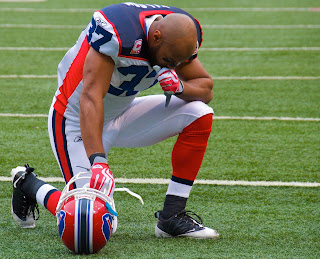
Image
Max Weber, my current go-to-guy in the sociological world, constructed a methodology for investigating society. One of the tools that he developed - an heuristic device, if you want to get technical - was the notion of the ideal-type. An ideal-type is a kind of utopian version of a thing, which despite not actually existing in reality, can be used as a substitute, or approximation, of a particular social reality. Let me exemplify. Sport is a social reality which takes many forms around the world, but the mention of the word conjures up a similar image in our minds no matter where we are from, and so evidently there are some clear commonalities which link sport in each context or locality. These commonalities, when pulled together, can be seen to make up a sort of short hand of the thing itself. We might say that an ideal type of sport is that it involves physical exertion, skill or prowess, it is competitive, organised, rationalised, and exists in hierarchical structures. Th...

Game Over: Sport Will Destroy Itself

Image
Tainted samples; missed tests; sabotaged games. Stories of illegal drug use in sport are seemingly more and more common.  The recent and frankly unsurprising news that the Russian Athletics Federation has been up to its neck in doping infractions, making a mockery of the sport (and the athletes) it is ostensibly serving, looks to have long lasting repercussions. But beyond the banning of a federation from an Olympic games, or the potential pro-Russian boycott that may result, there is one thing that is growing more apparent as the stories unfold... Drugs are destroying sport. But why do players, athletes, coaches and even entire federations make clandestine use of illegal and banned substances? The power structures that drive and sustain elite sport create enormous pressures on athletes to use illegal means to success. Let's briefly sketch three of these pressures. Status  Just about everybody knows Usain Bolt, or Serena Williams, or Lionel Messi. These are house...

The Protestant Play Ethic

Image
Do Protestant Christians today apply a 'work ethic' to their sporting endeavour? In this post I'll briefly be considering the possibility of a Protestant Play Ethic. Weber's Thesis Max Weber's Protestant Ethic and the Spirit of Capitalism remains a seminal text in the field of sociology, by virtue of the audacious range of his thesis as well as the subtlety and carefulness of his explication. Put crudely, Weber argued that Calvinism (a branch of Reformed Protestant Christianity) provided a worldview suited to the development of modern world order, and that this accounted for the rise of capitalism in Germany and much of Western Europe, rather than in Japan, for example. Critiques of Weber's thesis, including my own in a previous post , are numerous, varied and often contradictory. (For more on these contradictions as well as a synopsis of these critiques see Giddens' introduction to the 1976 edition of the English translation of The Protestant Ethic)...

Billy Sunday: The Baseball Evangelist

Image
"Preaching" by BPL - originally posted to Flickr as Preaching. Licensed under CC BY 2.0 via Commons - https://commons.wikimedia.org/wiki/File:Preaching.jpg#/media/File:Preaching.jpg Billy Sunday was a preacher and a Baseball player and one of the most powerful men of his generation. Born into poverty in 1862, his father died when the young William Ashley Sunday was just five weeks old. His mother, who, after a few years of support from her father, could no longer provide for her children, sent Billy and his elder brother to an orphanage in Iowa. Billy was fleet of foot and athletic as a young man and made his way into professional baseball with the Chicago White Stockings (now the Cubs) by the time he was 21 years old. He was reputedly the first man to round the bases in 14 seconds flat, and held the record for stolen bases for some years until it was surpassed by the legendary Ty Cobb.

To the Promised Land: Brazilian Footballers in Europe

Image
The religious landscape of Brazil has undergone seismic change in the last few decades. Where once the Catholic Church held unquestioned primacy of position, the decline in her influence over the nation has been sharp. It is claimed that in the 1940s 99% of Brazilians were Catholic, while the figure in 2013 was reported to be down to just 63%. In its place has risen the Protestant Church, and one broad denomination in particular - Pentecostalism. The most followed brand of Protestantism in Brazil is a version of neo-Pentecostalism which lays a central importance on profound personal experience(s) of the Holy Spirit alongside the accumulation of material wealth as a sign of God's favour.

Luther, Calvin & Weber

Image
Max Weber argues that ideas are more significant in shaping society than are the economic conditions of life. This is opposed to the doctrines of classical Marxism. Karl Marx believed that the material world produces the ways people think about their existence. Max Weber believed that the ways people think about their existence produces the material world. Marx was a materialist; Weber an idealist. Weber’s philosophical idealism led him to search for a set of beliefs, or ideas, which produced a worldview consistent with the development of the social setting in which he was living. Alongside this, Weber believed that he had observed a correlation between the emergence of modern capitalism and the predominance of Protestant (specifically Reformed, Calvinistic) belief. The very existence of this correlation has been substantially challenged – if not refuted – by numerous writers in the fields of history, economics and sociology. Nevertheless, and not without good reaso...

Non-muscular Christianity

Image
Probably not Jesus Christians grow tired of seeing Jesus Christ - He who willingly made the greatest sacrifice ever offered - portrayed as a somewhat wimpish, pallid and, dare I say, effeminate figure. One recourse amongst his followers has been to re-imagine the Christian body, the 'temple of the Holy Ghost', as a place of physical, sporting, and masculine strength. The idea of Muscular Christianity first grew from the writings of Thomas Hughes & Charles Kingsley. Hughes' book Tom Brown's School Days fictionalised and immortalised the work of Thomas Arnold, Christian headmaster of Rugby School in 1830s England, who encouraged the boys in his care to organise and take part in numerous sport and leisure activities. Arnold's intent was that the boys would grow into strong, principled Christian men, ready to take the Gospel to the world, and he believed that active energetic pursuits would be a key tool in their moral and spiritual education.

Popular posts from this blog

More than a Crest: the meaning of the Barça badge

Integrate - Disintegrate - Reintegrate

To the Promised Land: Brazilian Footballers in Europe